
Door Installation: Repair or Replace? How Columbus Homeowners Decide
A door that sticks, sags, or lets in a draft is usually asking a question the homeowner hasn’t heard yet. Repair makes sense when the slab and hinges are sound but the hardware or weatherstripping has worn out. Replacement is the honest answer when the frame has drifted, the jamb has softened, or the unit can no longer hold a seal against Columbus weather. If you’d rather not stand in the doorway with a level and a flashlight, call (888) 635-0804 and we’ll walk you through it.
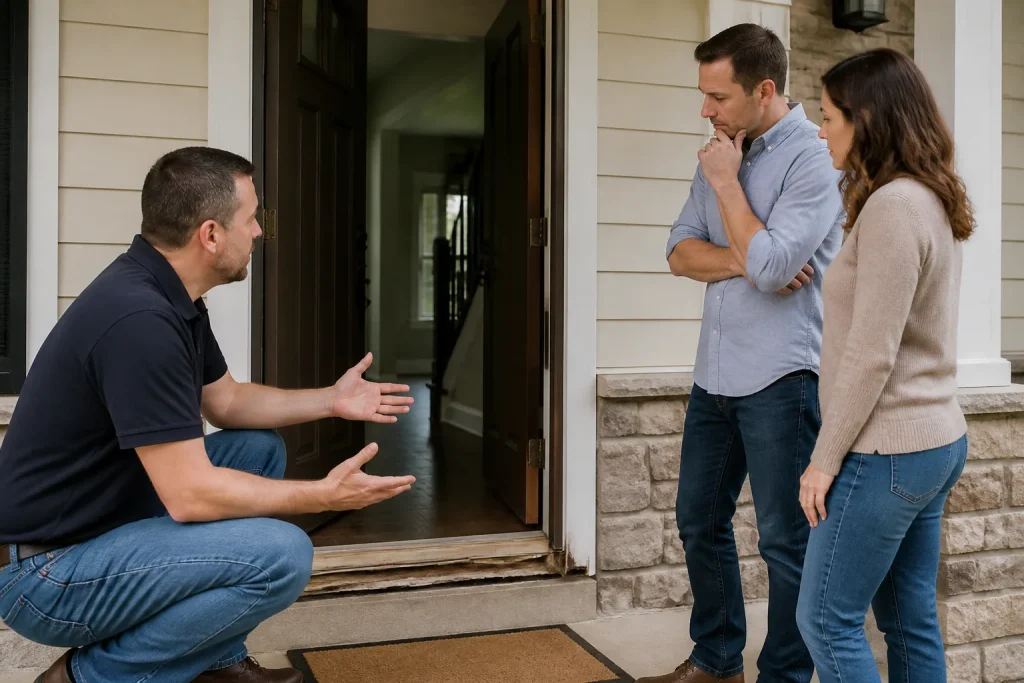
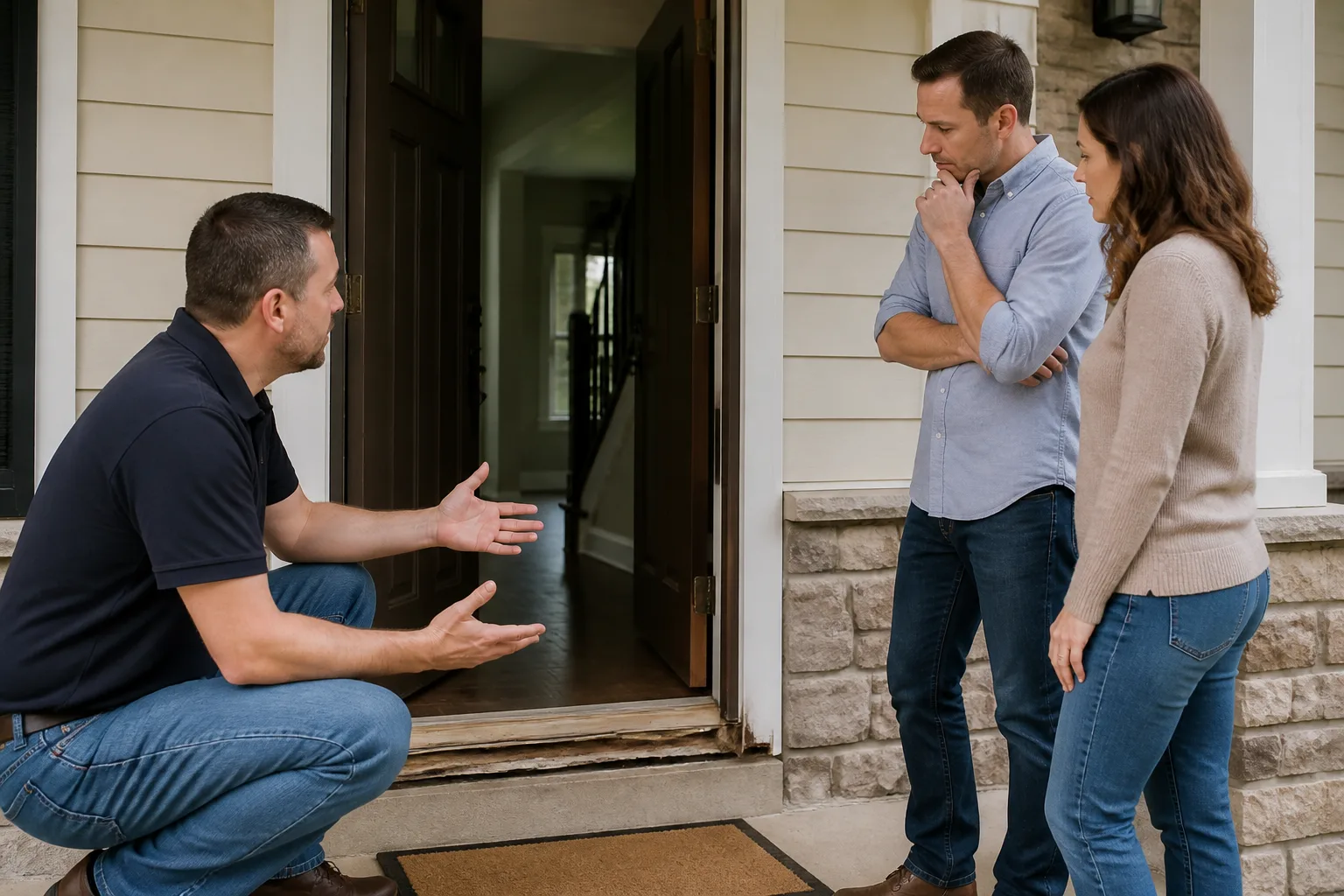
Most folks stand in front of a sticking door and assume the fix is a screwdriver job. Sometimes it is. Other times that sticking door has been telling you for two winters that the header above it has settled a quarter inch, and the real repair is a new frame, not a new hinge. After 42 years of pulling doors out of Columbus homes, we’ve learned the question is rarely “is this door annoying?” It’s “what is this door attached to, and is that still square?”
The Three Tests That Tell You What You’re Actually Dealing With
Before you call anyone, spend ten minutes with a level, a flashlight, and a piece of paper. These three checks won’t fix anything, but they’ll tell you whether you’re facing a hardware problem, a slab problem, or a frame problem. In Parkway and across Columbus, the distinction decides whether you spend $200 or $2,000.
Test one: the gap check. Close the door and run a dollar bill along the weatherstripping at the top, the latch side, and the bottom. If the bill slides freely in one spot and binds in another, the slab is out of plane with the frame. That’s not weatherstripping. That’s a frame that has moved.
Test two: the screwdriver test on the jamb. Remove one hinge screw and press the tip of a small screwdriver into the screw hole. If the wood gives like a sponge, moisture has been getting in and the jamb is rotting behind the trim. No hinge screw will ever hold in that again. This is the one we see most often on older Columbus back doors where gutter downspouts dump water too close to the foundation.
Test three: the level on the face. Hold a four-foot level vertically against the hinge-side jamb, then horizontally across the header. A door that’s out of plumb by less than an eighth of an inch is usually adjustable. More than a quarter inch means something structural has shifted, and adjusting the hinges is just rearranging the symptoms.
These tests matter because the big-box advice to “just replace the weatherstripping” assumes the frame is still where the builder left it. When a door frame in Columbus drifts, it’s often from freeze-thaw cycles working on the sill, or from a slab foundation settling unevenly. New weatherstripping on a drifted frame lasts one season and then you’re back where you started, with less money and more draft.
What’s Repairable and What’s Not: A Working Guide
We’ve fixed doors that other companies quoted for full replacement. We’ve also replaced doors that homeowners tried to patch three times before calling us. The line between the two isn’t the age of the door, it’s the condition of what surrounds it.
Here’s what’s typically repairable, assuming the frame is still solid:
- Worn hinge pins or bent hinges. A $30 hinge and fifteen minutes of adjustment. This is the best-case scenario for a sagging door.
- Air infiltration around the slab with a square frame. New compression weatherstripping, a door sweep, and a threshold adjustment usually close the gaps.
- Latch misalignment from normal house settling. Filing the strike plate or shimming one hinge can retrain the latch without touching the frame.
- Sticking at the top or latch side after paint. A light plane or hinge adjustment, as long as the jamb itself hasn’t moved.
Here’s what means the unit is done:
- Soft jamb wood at any hinge or strike location. You can’t anchor a door to rotten wood. The frame section has to be cut out and replaced, and if the rot has spread, the whole unit comes out.
- Visible gap movement between seasons. If the door binds in July but seals fine in January, the opening itself is changing size. A new slab in a moving opening is a Band-Aid on a wound that’s still bleeding.
- Condensation between the glass panes of a door with an integrated window or sidelight. The seal has failed. The energy performance is gone, and no resurfacing brings it back.
- Threshold rot that extends into the subfloor. This is the one that turns a door job into a small framing job, and in Columbus it’s almost always water management, not material failure.
We pulled a door out of a ranch house near Antrim Park last month where the homeowner had replaced the weatherstripping twice and the hinges once. The screwdriver test showed the hinge-side jamb was rotten from the bottom plate up eighteen inches. The door wasn’t sagging, the house was. New slab wouldn’t have fixed it. A new frame did.
Energy Performance: When the Door Is Costing You Real Money
Columbus heating and cooling bills run hard from November through March and then again in July and August. An aging door doesn’t announce its energy losses the way a cracked window does. It just sits there, bleeding conditioned air through gaps small enough to ignore and big enough to add up to a hundred dollars a season or more.
The honest math works like this: a wood door from the 1990s with a failed threshold seal and tired weatherstripping can lose the equivalent of a four-inch by four-inch hole in the wall when the wind blows. That’s not a metaphor. Air leakage rates on weathered doors regularly measure in the 25 to 35 CFM range under a 25 mph wind, which is what a Columbus January delivers with some regularity.
Replacement units from manufacturers like Pella, Marvin, Milgard, and Jeld-Wen now come with factory-installed compression seals, insulated cores, and thermal breaks in the frame. Installed correctly, they drop leakage to under 5 CFM. The payback in Parkway’s climate, where we swing from single-digit winter mornings to humid 90-degree summer afternoons, usually lands somewhere between six and ten years depending on the door’s exposure and how much you paid for the unit up front.
But here’s the part most energy auditors won’t tell you: the efficiency gain means nothing if the new door goes into a frame that’s still out of square. A quality replacement unit installed into a drifted opening will leak just like the old one. The frame is where the seal lives, and if the frame isn’t true, the seal never will be. That’s why we measure every opening twice before quoting, and why we often recommend fixing frame issues before the new door even arrives.
Why “Just Fix the Weatherstripping” Is Often Bad Advice
It sounds like the thrifty, sensible fix. And when the frame is square and the slab is sound, it is. The problem is that weatherstripping failures are usually a symptom, not the disease.
Weatherstripping fails for three reasons: age, wear from friction, or the gap it’s sealing has grown wider than the material can span. The first two are legitimate wear-and-tear. The third is the one nobody checks. A door frame that has shifted an eighth of an inch will spread the gap on one side beyond what even the bulkiest compression seal can handle. The weatherstripping didn’t “wear out.” The geometry changed under it.
This is where Columbus homeowners get burned. The big-box store sells them a $15 weatherstrip kit. They spend a Saturday installing it. The door seals better for a month or two, and then the same draft comes back because the gap kept widening, or the hinge screws kept pulling, or the threshold kept dropping. Now they’ve spent the afternoon, spent the $15, and still need the frame repair they should have looked for in the first place.
The diagnostic sequence matters. Check the frame first. If the frame is square and plumb, replace the weatherstripping with confidence. If the frame has moved, fix the frame or replace the unit. In Columbus, where freeze-thaw cycles work on exterior door frames every single winter, frame drift is more common than most homeowners think. The weatherstripping is just the canary.
What a Legitimate Door Replacement Quote Should Show You
When you sit down with a door quote, the first thing to do is look for line items. If the quote has one number and no breakdown, you can’t tell what you’re paying for, and you can’t compare bids fairly.
A straight quote for a door replacement in Columbus should itemize at minimum:
- The slab. Material, manufacturer, core type, and finish. Pella, Marvin, Milgard, and Jeld-Wen all make solid units. Ours quotes show the manufacturer name and model, not just “6-panel steel door.”
- The frame and jamb. Including any brickmould replacement and the shims needed to set the unit square. If rot has spread, this line expands. If a bid shows nothing for frame work, ask why. Every door has a frame.
- The threshold and sill pan. This is where Columbus water entry happens. A proper sill pan flashed and sealed under the threshold is the difference between a door that lasts thirty years and one that rots in ten. If the quote doesn’t mention it, that’s a corner being cut.
- Hardware. Hinges, lockset, handle, deadbolt. If the quote assumes you’ll reuse the visible hardware but doesn’t say so, you’ll find out on install day.
- Labor and disposal. Separated from materials. Not lumped. Lumped bids hide markups and make warranty questions harder later.
We quote every door with the frame, threshold, and hardware broken out on paper. It’s how we’ve always worked, and it’s the only way a homeowner in Columbus can spot where a low bid is cutting corners. Most of the time the “cheaper” quote isn’t cheaper. It’s just missing the piece that keeps the door dry.
And every quote we write carries the 90-Day Done Right Promise: if the door isn’t right, we make it right. No paperwork fight. No “that’s normal settling” runaround. The Keystone Standard means both warranty layers, manufacturer’s and ours, are registered in writing with durations stated before our truck leaves your driveway.
When to Call a Pro
If you’ve done the three tests in the first section and the answer is anything other than “hardware issue with a square frame,” you’re past the DIY point. Rotted jambs, moving openings, structural thresholds, and failed door glass seals all require removing the old unit, rebuilding what’s behind it, and resetting everything square. That’s not a Saturday project with a cordless drill and good intentions. It’s a two-person job with shims, a level, a flashing kit, and someone who’s done it four hundred times.
We’re background-checked and uniformed on every job, and we work in your home the way we’d work in our own mother’s. Dale Kessler founded TruePane in 2008 on a simple rule that’s still on the whiteboard: if the pane is not true, the job is not done. Doors are no different. The seal has to land. The latch has to catch clean. The threshold has to drain.
Related services in Columbus: if the door issue is paired with a window problem, we’ve covered window replacement in Parkway as a separate guide, and our door installation in Parkway page walks through what a full unit replacement involves. For window work specifically, see window installation in Parkway or start at the TruePane Windows & Doors home page.
The Bottom Line
Repair a door when the slab and hinges are sound and the frame is still square. Replace it when the jamb has softened, the opening has moved, or the threshold is rotting into the subfloor. In Columbus, where winter freeze-thaw and spring downpours work on exterior doors all year, the frame is the first thing to check and the last thing to cheap out on.
If you’re in Columbus or the Parkway area and you want a straight answer, TruePane Windows & Doors offers free estimates. Call (888) 635-0804 and talk to a real person. We’ve been serving local communities for over 42 years, and we plan to be right here answering the phone for thirty more.
Frequently Asked Questions
A straightforward frame repair, like replacing a rotted hinge-side jamb section, typically runs a few hundred dollars including labor and materials. A full frame rebuild with sill pan replacement can run higher. The final number depends on how far the rot has spread and whether the subfloor is involved. Call (888) 635-0804 for an exact quote, estimates are free.
Only replace the slab if the existing frame is square, solid, and dry. If the frame has drifted or any jamb wood is soft, a slab replacement wastes the money because the new door will bind and leak just like the old one. In our experience, most Columbus doors over twenty years old that need a slab also need at least some frame work.
A standard exterior door replacement, including frame, threshold, and trim, takes one full day for a straightforward install. If we find rot that extends into the subfloor or framing, the job may need a second day for the repair before the new unit goes in. We tell you the timeline before work starts, not after. Call (888) 635-0804 to schedule a free estimate.
Ours will. The Keystone Standard means both warranty layers, the manufacturer’s and our 90-Day Done Right Promise, are registered in writing with durations stated before our truck leaves the driveway. We’ve pulled too many doors where the homeowner thought they had a warranty and the fine print didn’t cover the failure. Not on our jobs.
Written by Dale Kessler, Owner at TruePane Windows & Doors, serving Columbus since 2008.
Need Windows & Doors Help?
Call TruePane Windows & Doors - licensed & insured, here with fast after-hours help in Columbus.
(888) 635-0804