
Jeld-Wen Window Installation in Columbus: A Homeowner’s Guide
Jeld-Wen window installation in Columbus typically costs between $300 and $900 per window for labor alone, depending on whether you’re dealing with new construction flanges or replacement inserts in existing frames. The bigger question isn’t the price, though. It’s whether the crew setting the window understands what Jeld-Wen’s own documentation requires, because a surprising number of warranty claims in central Ohio trace back to installation shortcuts, not factory defects. If you’d rather not wade through warranty fine print, call (888) 635-0804 and we’ll walk you through it.
Here’s the thing about Jeld-Wen most homeowners don’t realize until something goes wrong. The company settled a class-action lawsuit over wood-core delamination in 2022. That doesn’t mean their windows are bad. It means the warranty language matters more than the brochure language, and installation method matters more than either one. A properly installed Jeld-Wen window in a Columbus home will perform for decades. An improperly installed one will fail inside of five years, and the warranty won’t save you because the fine print points right back at the installation.
What the Jeld-Wen Product Warranty Actually Covers (And What It Doesn’t)
Jeld-Wen’s standard limited warranty for residential windows covers factory defects in materials and workmanship. Glass sealed units are generally covered for twenty years against visual obstruction from seal failure. Non-glass components like frames, sashes, and hardware carry a ten-year limited warranty on most series. Vinyl windows from the V-2500 and premium vinyl lines typically carry limited lifetime coverage for the original homeowner. These are manufacturer numbers, not installation numbers, and that distinction matters more than most people think.
Here’s where Columbus homeowners get burned. The Jeld-Wen warranty explicitly excludes damage resulting from improper installation. It excludes water infiltration caused by incorrect flashing. It excludes seal failures traced to out-of-square rough openings that force the frame to twist. In other words, the manufacturer warranty covers what happened in the factory. Your installation warranty is a separate layer entirely, and if the crew that set your windows didn’t register both layers in writing, you’re holding a piece of paper that covers neither.
At TruePane Windows & Doors, we register both warranty layers in writing before the truck leaves the driveway. The Keystone Standard isn’t a slogan. It’s a checklist: manufacturer warranty registered in your name, duration stated on the document, and our own 90-Day Done Right Promise covering workmanship. If it’s not done right, we make it right. No paperwork, no arguing, no fine print that covers neither.
Wood-Core vs. Composite: Why the Installation Method Has to Change
Jeld-Wen makes hundreds of window lines, but for Columbus homes the two families you’ll actually encounter are wood-core (the Architect Series, the Siteline line, and the classic wooden double-hungs common in Clintonville and Victorian Village) and composite or vinyl lines (the V-2500, Premium Vinyl, and Builders Series). These products do not install the same way, and crews that treat them interchangeably create problems that don’t show up for two or three Ohio winters.
Wood-core Jeld-Wen windows require a specific shimming sequence at the sill, the quarter points, and the head, with shims placed in pairs and never single-stacked. Jeld-Wen’s technical guide calls for shims at every point where a fastener enters the frame. This keeps the frame from bowing when the screws pull tight. Skip the shims and you’ll get a sash that binds in July and leaks in January. We’ve pulled wood windows out of homes in German Village where the installer ran screws with no shims at all, and the frame was visibly hour-glassed. The homeowner thought the window warped. The install warped it.
Composite and vinyl Jeld-Wen units are more flexible, which means the shim tolerance is tighter, not looser. These frames move with temperature swings, and if the rough opening isn’t square within a quarter inch, the frame flexes at the corners and the weatherstripping never seats quite right. In Columbus, where we swing from below zero to near a hundred, that movement is constant. A vinyl Jeld-Wen window in an out-of-square opening will eventually develop air leaks at the corners. The fix starts with measuring the rough opening twice, a habit we require on every job.
The Installation Steps Most Crews Skip (Because They Add Twenty Minutes)
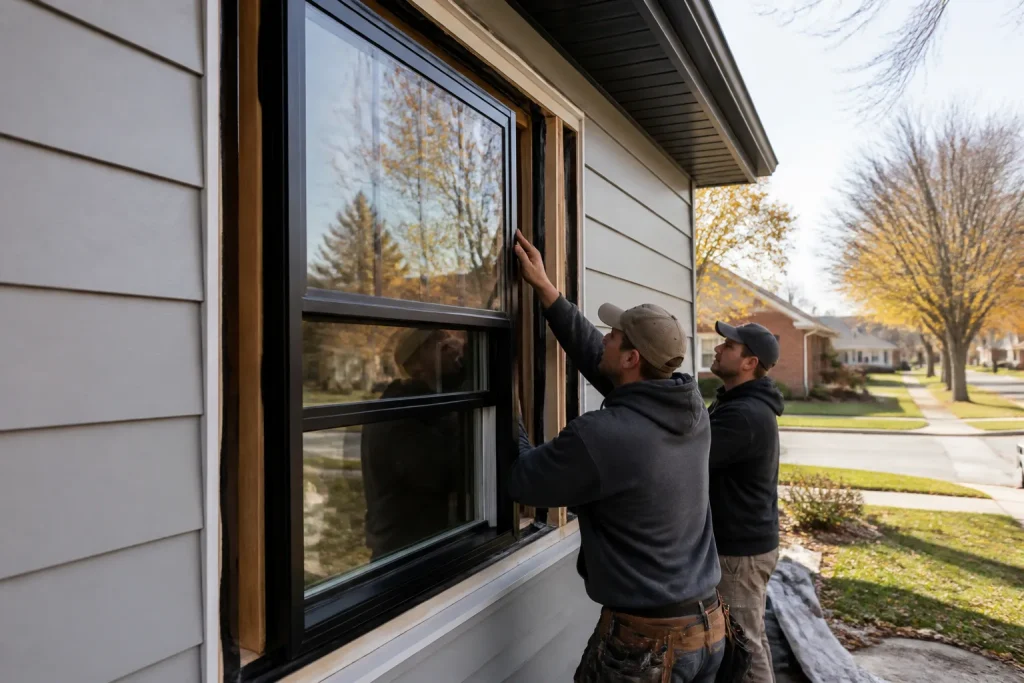
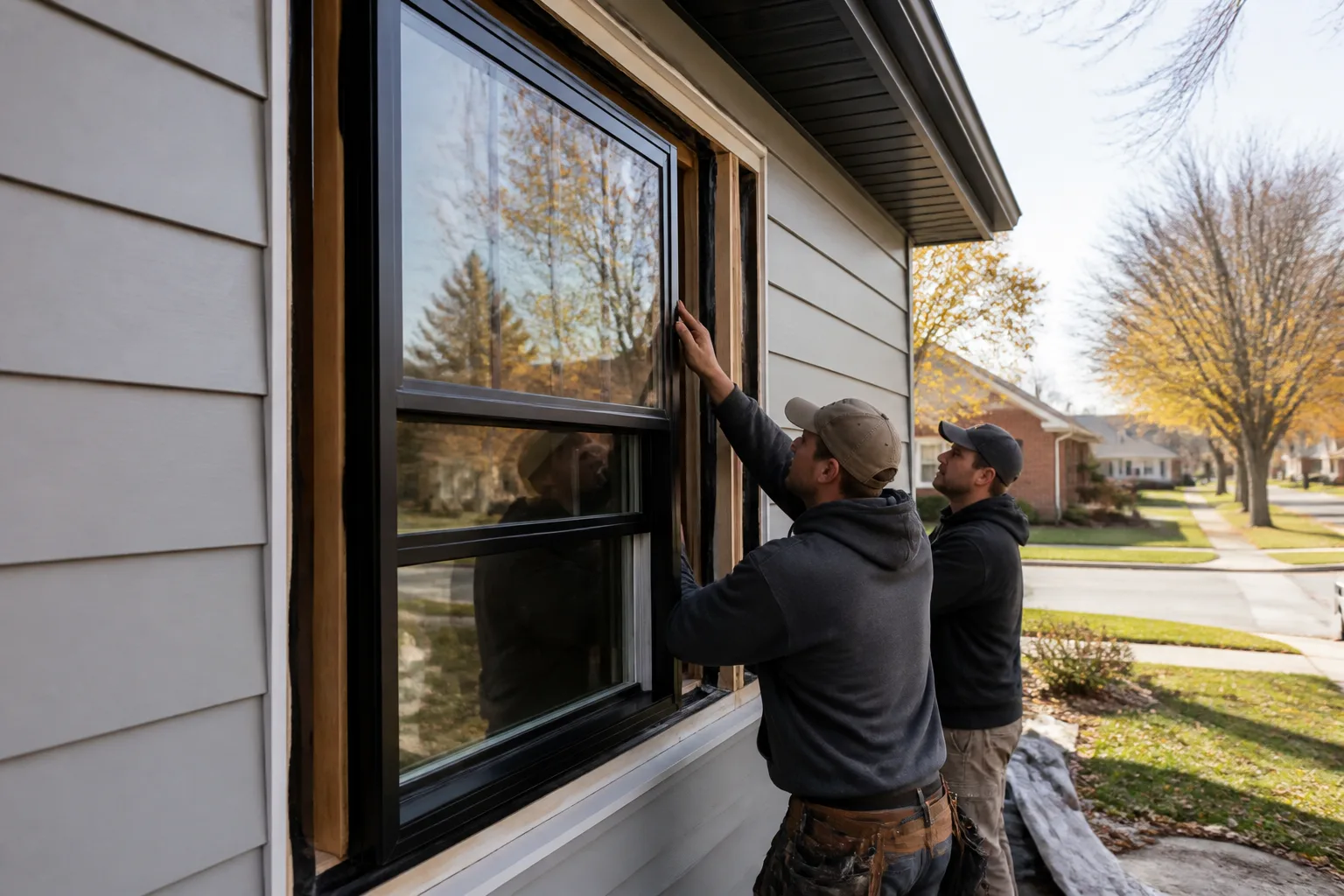
Jeld-Wen publishes a technical installation guide for every window line. It’s available online. Most residential crews never open it. Here’s what the guide requires that routinely gets skipped in Columbus, and why each skipped step matters.
- Flashing tape sequence at the sill, jamb, and head. Jeld-Wen’s flange design assumes a specific layering order: sill pan first, then jamb flashing lapping over the sill, then head flashing lapping over the jambs. Water always sheddds down and out. Reverse the lapping order and you’ve built a funnel into the wall. In stucco exteriors, common throughout Columbus’s older neighborhoods, the head flashing has to tuck behind the housewrap and the stucco lath, not sit on top of it.
- Backer rod and sealant, not just caulk. The guide calls for backer rod behind the exterior sealant joint to control sealant depth. Caulk alone in a half-inch gap will crack within two seasons. We see this on stucco homes in Upper Arlington and Bexley all the time: a clean caulk line on the outside, and rot starting behind it.
- Drainage plane continuity. The housewrap has to lap correctly around the window opening before the unit ever goes in. Cut the housewrap in an X and fold it in? That’s wrong for flanged windows. Jeld-Wen requires the wrap to be cut flush at the head and lapped over the sill flashing at the bottom. It’s a twenty-minute difference per opening. It’s also the difference between a dry wall cavity and a mold problem behind the drywall.
- Level and square before the first screw. A 1/8-inch out-of-square on a 36-inch wide window becomes a 1/4-inch gap at the operable sash. The guide says to check diagonal measurements and adjust with shims before securing. Most crews check nothing. They set the frame, shim by eye, and run screws. That window will operate, but it’ll never operate right.
This isn’t craftsmanship for its own sake. These steps exist because Jeld-Wen’s engineering team documented exactly where their windows fail when these steps get skipped. If you’re paying for a quality window, you should be paying for the installation method that keeps it under warranty.
How to Register Your Jeld-Wen Warranty in Your Own Name
Here’s a scenario we see at least once a month in Columbus. A homeowner in Westerville or Gahanna calls because their Jeld-Wen window fogged. They have the original paperwork. They call the manufacturer. Jeld-Wen tells them the warranty was never registered, or it was registered in the contractor’s name, or the registration happened eighteen months after installation and the coverage window closed. The homeowner is stuck.
Jeld-Wen warranty registration is time-sensitive on most lines. The homeowner’s name has to be on the registration, not the contractor’s, and it has to be filed within the required window after installation. Some series require registration within 90 days. Some allow no transfer if the registration was never completed. The practical rule: you should leave the installation with a copy of the registration form already filed and a written statement of coverage duration.
This is where our warranty process exists for a reason. Before the truck leaves the driveway, both warranty layers are registered in writing. The manufacturer warranty is in your name, with the duration stated on the document. Our workmanship warranty is in writing too, backed by the 90-Day Done Right Promise. You shouldn’t have to trust that your windows are covered. You should be able to read it.
Stucco Exteriors and Jeld-Wen Flanges: Where Columbus Homes Leak
A large share of Columbus homes built before 1980 have stucco exteriors. The neighborhood around Beechwold, large parts of Bexley, and scattered houses throughout the Short North are stucco over wood frame. Stucco isn’t waterproof. It’s a water-shedding system, which means the flashing behind it does the real work. That’s where Jeld-Wen flange installation gets delicate.
On a stucco home, water that gets behind the stucco travels down along the housewrap. The window head flashing has to be tucked up under the housewrap so that migrating water stays on the surface of the wrap, not behind it. The sill flashing has to extend past the stucco termination at the bottom of the opening. If either detail is wrong, water ends up running along the rough opening and into the wall cavity. By the time it shows up inside, the structural damage is already done.
We pulled a Jeld-Wen unit out of a stucco house in Clintonville last fall where the installer had tape-flashed the head over the housewrap instead of under it. Every rain event had been funneling water behind the wrap into the stud bay. The homeowner’s visible symptom was a small water stain on the drywall below the window. The reality was a rotted sill plate and a thousand-dollar masonry repair on top of the window replacement. The window itself was fine. The installation wasn’t.
If you have a stucco home in Columbus and you’re replacing windows, ask the contractor how they handle head flashing behind the housewrap. If they don’t have an immediate answer, keep looking.
When to Call a Pro (And When a Handyman Is a Gamble)
There’s a version of this job a careful homeowner can do. A replacement insert in a square, rot-free frame with vinyl siding is within reach for someone with experience and the right tools. But if your Columbus home has stucco, if the rough opening has any rot, if the window is anything other than a same-size replacement, or if you’re installing flanged new-construction units, the calculus changes fast.
High-tension springs and cables aren’t part of window work, but the structural risks are real in a different way. An improperly flashed window leaks slowly, invisibly, for years before anyone notices. The damage is in the wall cavity, not the room. You can’t see it from the inside, and by the time you can, the repair costs more than the original window. A trained professional catches the rot before the window goes in, corrects the flashing detail, and stands behind the work. We’d never suggest a homeowner with no flashing experience take on a stucco-wall window replacement. The stakes are too high and the failure mode is too quiet.
If you’re in Columbus and you want a second set of eyes on a Jeld-Wen installation already in progress, or you’re comparing quotes and need to know which details to check, we’re happy to help. Related services in Columbus we handle regularly include Window Installation in Parkway and Window Replacement in Parkway, along with Door Installation in Parkway. If the pane is not true, the job is not done.
Key Takeaways for Jeld-Wen Installation in Columbus
- Jeld-Wen wood-core and vinyl/composite lines have different shimming and flashing requirements. A crew that treats them the same will eventually produce a binding sash or a leaking frame.
- The Jeld-Wen product warranty excludes improper installation. Your installation warranty is a separate layer, and both must be registered in writing, in your name, at the time of install.
- Stucco homes in Columbus need head flashing tucked behind the housewrap and sill flashing that extends past the stucco termination. Getting this wrong causes hidden wall-cavity damage.
- The installation steps most crews skip add twenty minutes per unit and are the difference between a dry wall cavity and a slow leak.
- Never leave a Jeld-Wen install without written proof of warranty registration in your own name.
The Bottom Line
Jeld-Wen makes a solid window at a fair price, and the brand’s ubiquity means the product has been tested in every climate in America, including Ohio’s freeze-thaw cycles. The variable isn’t the window. It’s the hands that set it. If you’re in Columbus and you’re replacing windows, ask about shimming sequences, flashing laps, and warranty registration. A contractor who can answer those questions clearly is worth more than any discount on the bid.
TruePane Windows & Doors has been serving Columbus homeowners since 2008, founded by Dale Kessler on the principle that out-of-true installs and voided warranties were problems worth fixing permanently. We’re an authorized installer for dozens of manufacturer lines including Jeld-Wen, PGT, and CGI, and we quote manufacturer lines side by side on paper so you see exactly what you’re buying. Every install carries the Keystone Standard: both warranty layers registered in writing, durations stated, before the truck leaves your driveway. If you’re in Columbus and need Jeld-Wen windows installed correctly, call (888) 635-0804 for a free estimate. A live person answers, 24/7.
Frequently Asked Questions
Labor for Jeld-Wen window installation in Columbus typically runs $300 to $900 per window, with replacement inserts at the lower end and full-frame or stucco-detail work at the higher end. Material costs vary widely by series. For an exact quote on your Columbus home, call (888) 635-0804. Estimates are free.
No. The Jeld-Wen product warranty covers factory defects only. Damage from improper installation, incorrect flashing, or out-of-square openings is explicitly excluded. Your installer’s workmanship warranty is a separate layer, and if it isn’t in writing, it isn’t worth the paper it’s printed on. Call (888) 635-0804 to have your current installation checked before the warranty window closes.
A typical same-size replacement install runs 45 to 90 minutes per window for an experienced two-person crew, not including rot repair or stucco flashing corrections. Full-frame replacements on stucco homes can take half a day per unit when the flashing detail is done correctly. For a realistic timeline on your Columbus home, call (888) 635-0804.
The manufacturer warranty doesn’t require a specific contractor, but the installation method has to match Jeld-Wen’s technical guide or coverage gets denied when a claim is filed. Shimming sequences, flashing laps, and registration deadlines are all part of the determination. If your handyman can’t walk you through Jeld-Wen’s flashing requirements for stucco, the risk is on you. Call (888) 635-0804 for a free professional assessment.
Written by Dale Kessler, Owner at TruePane Windows & Doors, serving Columbus since 2008.
Need Windows & Doors Help?
Call TruePane Windows & Doors - licensed & insured, here with fast after-hours help in Columbus.
(888) 635-0804