
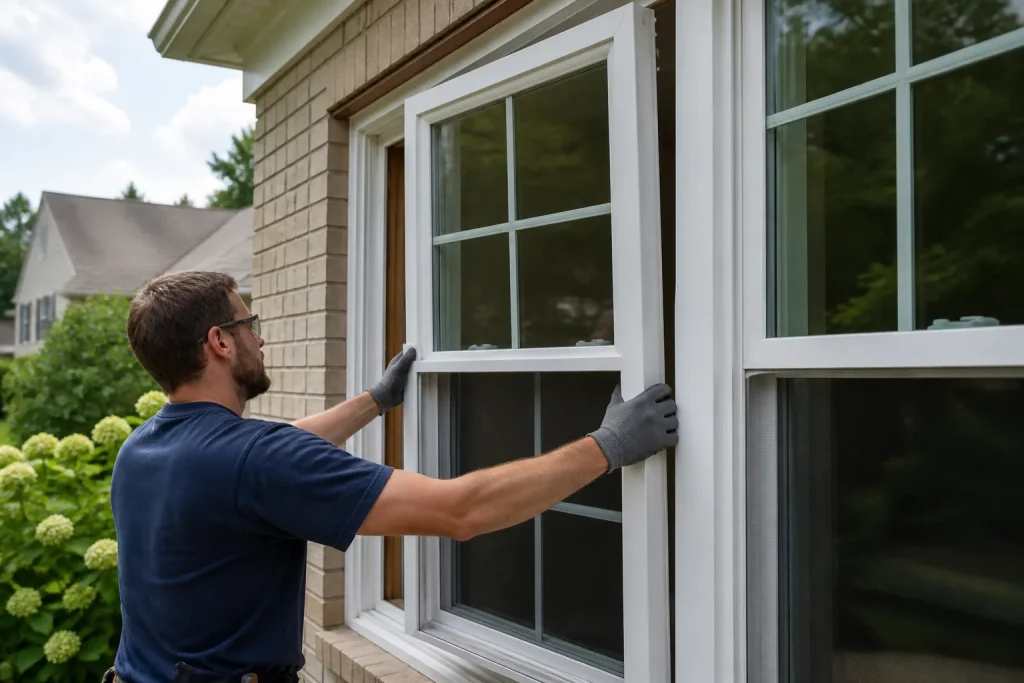
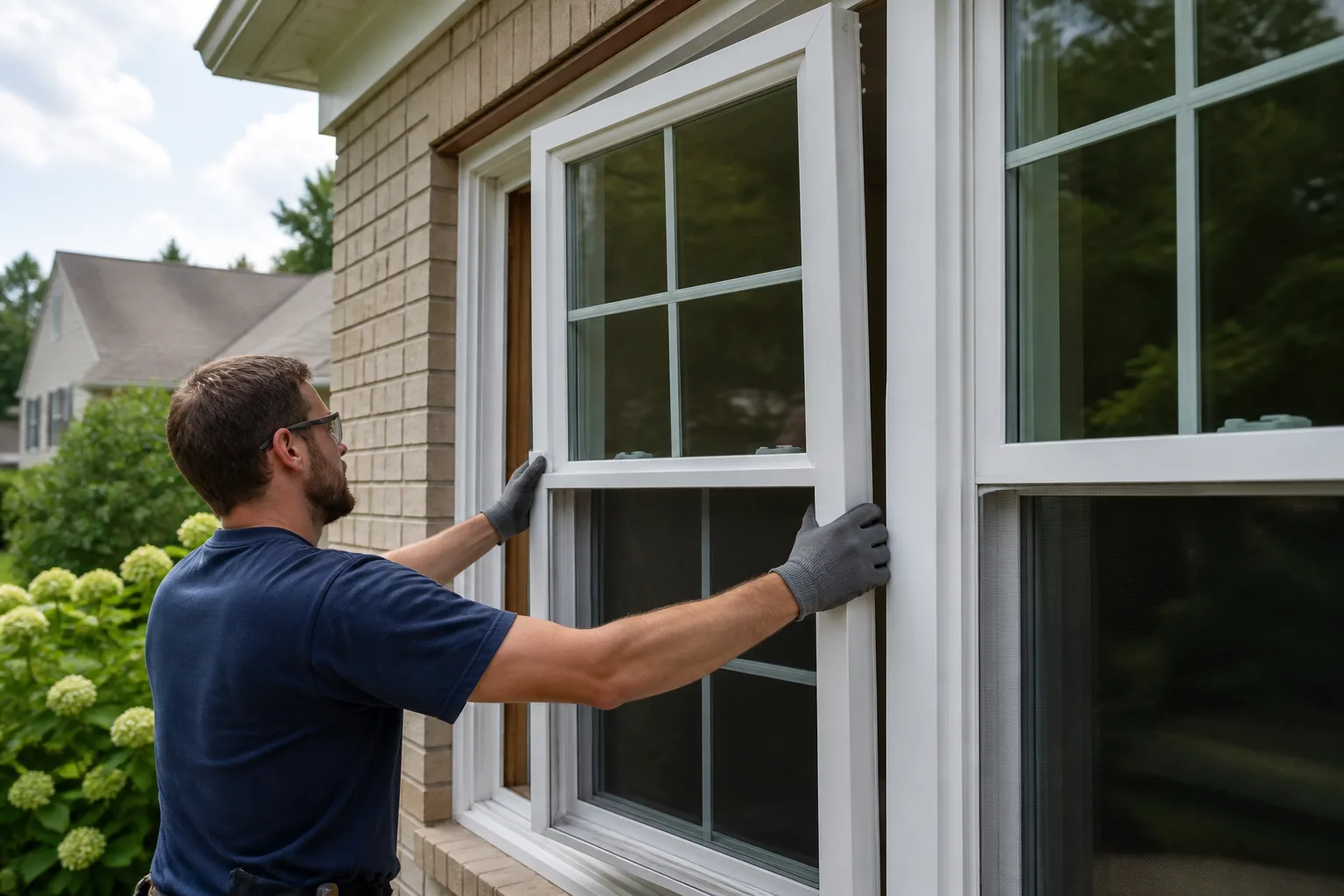
Simonton Window Installation in Columbus: A Homeowner’s Guide
Simonton makes a solid mid-tier vinyl window, but the installation is where these units either hold up for twenty years or start binding and fogging inside of five. The difference comes down to whether the crew follows Simonton’s published installation tolerances for shim placement and fastener spacing, not just whether they’ve hung windows before. If you’re planning a Simonton install in Columbus and want it done right the first time, here’s what matters, and if you’d rather not sort through it yourself, call (888) 635-0804 for a free estimate.
What Simonton’s Vinyl Expansion Means for a Columbus Install
Vinyl expands and contracts with temperature, and Simonton publishes specific rates for their extrusion blends. The ProFinish Contractor series, which is the line most Columbus homeowners end up with, uses a rigid vinyl formulation with a thermal expansion coefficient in the range of 3.4 to 4.0 x 10⁻⁵ in/in/°F. What that means on the wall is straightforward: a 36-inch-wide frame moving through a 60-degree seasonal swing in Columbus will shift roughly 1/16 of an inch over the course of a year.
That movement is normal, but it means the shim gap at the head and sill has to be left open enough to absorb it. Simonton’s technical installation guides call for shims at every anchor point, with a gap between the top of the frame and the rough opening header maintained so the vinyl isn’t pinched when it grows on a 95-degree July afternoon. The crews we follow behind in Columbus frequently shim the window tight to the header the same way they would a wood or aluminum unit, and inside of a few seasons that frame starts bowing at the corners where the pressure builds up. The window didn’t fail. The installation did.
Simonton also specifies fastener placement relative to the nailing flange slots, and the ProFinish series is unforgiving about it. Every pre-punched slot gets a fastener, and the fastener goes through the center of the elongated hole, not snugged tight against one end. When a crew drives the fastener against the end of the slot, they’ve converted that slot from an expansion joint into a fixed point. It’s a small thing to look at and a big thing to live with once the seals start wearing unevenly.
Simonton’s Warranty Tiers: What “Limited Lifetime” Actually Covers
Simonton’s warranty language varies by series, and the phrase “limited lifetime” does not mean one uniform promise across the catalog. The company organizes its products into lines, and each line carries its own coverage document with its own exclusions. The Reflections series, the ProFinish Contractor series, and the DaylightMax series each sit in a different tier, and the differences matter when you’re comparing quotes in Columbus.
In broad terms, Simonton’s standard warranty covers the vinyl frame and sash against cracking, warping, and manufacturing defects for as long as you own the home on most of their residential lines. The glass seal failure coverage is where the tiers diverge. Some series carry a lifetime transferable seal failure warranty, others cap it at twenty years, and on certain entry-level lines the seal coverage drops to ten. The transfer provision matters a lot to a homeowner who might sell in a decade, because a non-transferable warranty adds nothing to the sale price and leaves the next owner holding the risk.
This is one place where the paperwork should be in your hand before the crew leaves the driveway. We register both warranty layers in writing at TruePane, with durations stated on the invoice and a copy of the manufacturer registration confirmation passed to the homeowner. If a Columbus contractor can’t tell you which Simonton warranty tier you’re buying, or won’t put the coverage terms on paper, that’s a signal you’re dealing with a crew that’s selling boxes, not standing behind the window. For a comparison against other brands like window replacement options in Parkway, the warranty structure is usually the deciding factor once the glass specs are equal.
Simonton-Authorized Installer vs. a Crew That Carries Simonton Product
Any contractor with an account at a supply house can buy Simonton product. That does not make them a Simonton-authorized installer, and the distinction is not semantics. Simonton’s published warranty coverage requires that the window be installed according to their installation instructions, and the company maintains a network of trained installers who have gone through their factory-level or field-level training. When a problem comes up, Simonton’s first question is often whether the installer was authorized and whether the install followed the book. If the answer to either is no, the warranty path gets narrow fast.
You can verify authorization before you sign. Ask the contractor for their Simonton installer ID or authorized dealer number. Then call Simonton directly and confirm it. A company that actually carries the authorization will give you the number without blinking. A company that’s been buying product through a third party will shuffle. We carry authorized status with more than a dozen manufacturers, and we’ll put the list on the quote so you can verify any of them, including Simonton, with a phone call.
Columbus homeowners sometimes ask why this matters when the window looks the same. It matters the first time a seal fails at year nine and the manufacturer asks for the installer’s credential number. It matters when you’re filing a claim and the paperwork from year one is incomplete. The window is a product. The installation is the transaction that keeps the product under warranty. If the installer isn’t authorized, you effectively bought the window as-is on the day the truck pulled away.
Flashing Simonton Flanged Units on Columbus Stucco vs. Wood Siding
Simonton’s ProFinish Contractor units ship with an integral nailing flange around the perimeter, and the flashing detail changes completely depending on what the exterior wall is made of. In Columbus, you see plenty of both stucco and wood-framed siding, and a crew that flashes both the same way is asking for water intrusion inside of a few years.
On a wood-sided home, the standard sequence is straightforward: peel-and-stick flashing at the sill, housewrap or building paper lapped correctly, the window set into the opening, then flashing tape over the side flanges and finally over the head flange, with the top tape tucked under the housewrap so water drains outward instead of running behind the frame. The window’s own top flange does not act as the primary water diversion. The tape above it does.
On a Columbus stucco home, the water management has to happen before the stucco is patched, and the detail that most crews miss is the back dam at the sill. Without an integrated sill pan flashing that slopes outward and turns up at the interior edge, any water that finds its way past the stucco crack sits against the bottom of the Simonton frame and works on the seal from the bottom up. We’ve pulled Simonton units out of stucco homes where the glass was still clear but the frame corners had rotted the rough opening out because someone skipped the pan flashing and just caulked everything. Stucco doesn’t shed water. It absorbs it. The flashing detail carries the whole weight of keeping it out.
Documenting Your Simonton Installation for Warranty Protection
The warranty only matters if you can prove what was installed, when it was installed, and who installed it. Most Columbus homeowners filing a claim ten years after the fact don’t have any of that in one place. The fix is simple, and it all happens on installation day.
- Photograph everything before the crew leaves. Framing with shims visible, flashing tape at the corners, the exterior flange after it’s flashed, and the interior trim once it’s set. Every window, not just the one you can see from the couch.
- Keep the Simonton product label from each unit. Each window ships with a sticker or laser-etched ID that carries the series, glass package, and manufacturing date. That label is the key to the specific warranty tier you bought.
- Get the installer’s registration confirmation in writing. Simonton allows installers to register the product on your behalf, and you should receive a copy of that registration with the product ID numbers listed before the check clears.
- Match the quote to the final invoice line by line. If the quote says ProFinish Contractor series with Low-E 366 glass, the invoice should say the same thing. A mismatch is the first thing the warranty department looks for.
- Ask where the warranty paperwork is filed. We register both warranty layers at TruePane, and the durations are stated on the paper we hand you. If your Columbus installer tells you the warranty is “handled” and gives you nothing, it isn’t handled.
The goal is a folder you can hand to a claims adjuster or the next owner of the house. Ten minutes of documentation on install day beats six months of arguing later. We’ve seen it go both ways, and the difference is always the paper trail.
Simonton vs. Other Mid-Tier Vinyl Brands in Columbus
Homeowners shopping Simonton against Pella, Marvin, or Milgard are usually comparing price against glass package, and that’s the right place to start. Simonton’s ProFinish Contractor series competes on delivered cost, and in Columbus it’s typically priced below a comparable Marvin Essential and above a builder-grade box store unit. Where the value lands depends on what you’re asking the window to do.
For a straight-up replacement in a bedroom or living room, Simonton’s DaylightMax glass package performs well, with a U-factor and solar heat gain coefficient that meets Energy Star Northern zone requirements for Ohio. For a window that’s taking direct afternoon sun on the west side of a Columbus house, the Low-E 366 coating on Simonton’s upper lines makes a measurable difference in heat gain compared to the entry-level glass. None of that is unique to Simonton, but the price point they hit with those packages often is.
Where we see Simonton lose ground is in the details. The hardware on some Simonton lines is lighter than what Pella and Marvin put on their mid-tier units, and the frame corner welds on the ProFinish series are functional but don’t have the finished look of a Milgard Tuscany. If the window is going in a room you use every day and you’re going to live with it for twenty years, the difference between a Simonton and a Marvin is something you’ll notice every time you open it. We’ll quote Simonton alongside Pella, Marvin, and Milgard on the same sheet at TruePane so you can see the numbers side by side, not across three different sales pitches. Our window installation service in Parkway covers all of these lines, and we walk you through the trade-offs without pushing the one with the best margin.
One more thing Columbus buyers should know: Simonton was acquired by Fortune Brands in 2024, and the product line consolidation that followed means some series that were available five years ago are being phased out. If you’re replacing one Simonton window in a house full of them, verify that the series is still in production before you commit. A discontinued series can’t always be matched for sightlines and frame profiles, and a mismatched window in a row of identical units is the kind of thing that bothers you every morning for the rest of the time you own the house.
Signs Your Simonton Install Was Done Wrong
Not every failed Simonton window announces itself with a fogged pane. Some problems show up as subtle as a draft in February or a latch that doesn’t line up in August. In Columbus, where the seasonal temperature swing is wide enough to flex vinyl daily for months, a bad install tends to reveal itself within the first two years.
Watch for these after your Simonton install:
- Binding or hard operation in summer. If the sash suddenly sticks in July but worked fine in April, the frame was likely shimmed too tight at the head and the vinyl is now pressing against the rough opening. This is the most common Columbus-specific failure we see.
- Uneven gaps between the sash and frame. Run a dollar bill around the closed sash. It should drag evenly. If it falls out in one corner and won’t move in another, the frame is racked, which means the shims weren’t placed to keep the unit square.
- Drafts at the corners in winter. Cold air moving through the corner joints points to a frame that was twisted during installation or a fastener pattern that pulled the frame out of plane. The seal can’t do its job if the frame isn’t square.
- Caulk cracking within the first season. If the exterior caulk joint opens up by the first spring, the window is moving more than the flashing detail can accommodate. That’s an expansion problem, and it started the day the shims went in wrong.
If you’re seeing any of these, don’t wait. A window that’s shifting will keep shifting, and the fix usually means pulling the interior trim, re-shimming, and re-flashing. The longer it goes, the more likely the rough opening is taking on water. When to call a pro? When the window is binding, leaking, or fogged, the pro is already the answer. This isn’t a caulk-and-paint fix. It’s a re-installation of the unit, and it needs the same care as the first time around. If the pane isn’t true, the job isn’t done.
The Bottom Line
Simonton makes a good window at a fair price, and a properly installed Simonton unit in Columbus will last as long as most homeowners stay in the house. The problem is that Simonton’s vinyl formulation demands a specific installation approach: shims at every anchor point, a gap at the head for expansion, fasteners centered in the elongated slots, and flashing that matches the exterior wall system. Most crews hang them the same way they hang every other window, and the homeowner pays for it later in the form of a binding sash or a fogged seal that the warranty won’t cover because the install deviated from the manufacturer’s book.
If you’re in Columbus and planning a Simonton install, get the warranty tier in writing, verify the installer’s authorization directly with Simonton, and document everything on installation day. If you’d rather have a company that handles all of that and stands behind the work, TruePane Windows & Doors has been serving Columbus and the surrounding communities since 2008. Our 90-Day Done Right Promise covers the workmanship, and The Keystone Standard means both warranty layers are registered in writing before our truck leaves your driveway. Call (888) 635-0804 for a free estimate, and we’ll walk the job with you before anything gets ordered.
Frequently Asked Questions
For a standard double-hung replacement in an average Columbus home, expect to pay between $600 and $1,100 per window installed, including the unit, flashing, interior trim work, and disposal of the old window. Larger units, stucco exteriors, and homes with lead paint abatement requirements push that number higher. The Simonton series you choose moves the price more than anything: a ProFinish Contractor double-hung runs lower than a DaylightMax with upgraded glass, and the installation labor is roughly the same either way. Call (888) 635-0804 for an exact quote on your specific openings. Estimates are free.
Yes, with the right glass package. Simonton’s frames hold up well in cold winters, and their Low-E 366 glass helps manage the summer heat gain that Columbus sees from June through early September. The vinyl formulation is designed for full seasonal temperature swings, which is why the installation tolerances matter so much in a climate like Ohio’s. A Simonton window installed with the proper expansion gaps will handle Ohio weather for decades. The same window pinned too tight to the header will fail early, and it won’t be the window’s fault.
A typical whole-house replacement of 10 to 14 windows takes two to three days for a two-person crew. A single window replacement is usually done in a few hours. The variables are the exterior wall material, the condition of the rough openings, and whether interior trim needs to be matched or replaced. If you’re in Columbus and need a timeline for your specific job, call (888) 635-0804 and we’ll give you a straight answer based on what’s actually in your house.
No. Simonton’s warranty covers defects in materials and manufacturing. It does not cover failures caused by improper installation, and the warranty language is specific about that. If a window leaks because the flashing was done wrong, or the frame warps because the shims were too tight, the claim path goes through the installer, not the manufacturer. That’s why installation documentation matters so much. When you work with a company that registers the warranty and stands behind the labor, you have someone to call instead of a fine-print fight. Call (888) 635-0804 if you want to talk through what proper installation looks like for your Columbus home.
Written by Dale Kessler, Owner at TruePane Windows & Doors, serving Columbus since 2008.
Need Windows & Doors Help?
Call TruePane Windows & Doors - licensed & insured, here with fast after-hours help in Columbus.
(888) 635-0804